Understanding Dislocated Hips in Dogs and Cats

The hip joint plays an important role in your pet's ability to walk, run, jump, and stay active. A dislocated hip, also known as hip luxation, is a serious injury that can cause pain and affect mobility. Understanding the signs and available treatment options can help support your pet's recovery.
Understanding the condition

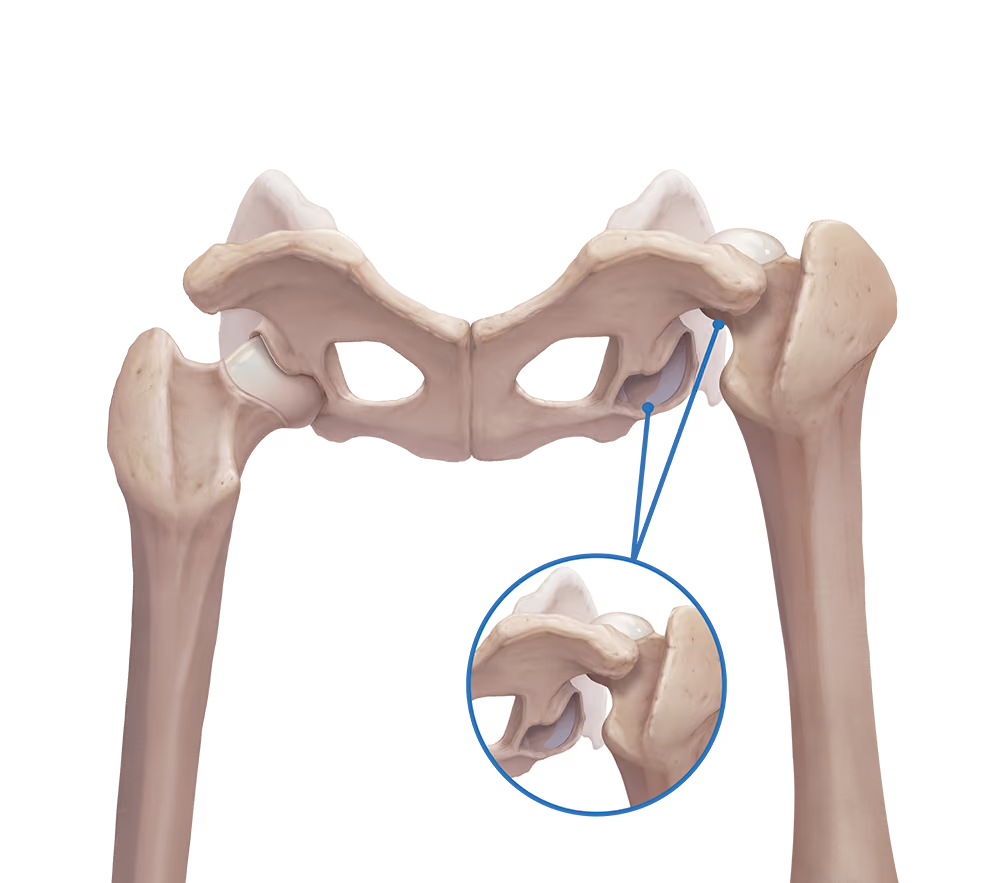
The hip is a ball-and-socket joint. The “ball” is the top of the thigh bone (femur), and the “socket” is part of the pelvis. A hip dislocation occurs when the ball is forced out of the socket, causing the joint to come apart. In most cases, the ball moves up and forward out of the socket, but it can sometimes move downward instead.

This type of injury is most commonly caused by trauma, such as being hit by a car or experiencing a significant fall. However, it can happen with less obvious injury. When the hip becomes dislocated, the tissues that normally hold the joint in place are damaged. This makes the joint unstable and prevents it from working normally.

Signs and Symptoms

A dislocated hip can affect pets differently depending on the severity and direction of the dislocation. Common signs may include difficulty or inability to put weight on the leg, unusual positioning of the leg with the foot turned inward or outward, one leg appearing shorter or longer than normal, pain, swelling, or reluctance to move.

Diagnosis

Your veterinarian will perform a physical examination and evaluate how your pet stands, walks, and uses the affected limb. X-rays are typically needed to confirm the diagnosis, determine the position of the dislocated joint, and identify any additional injuries, such as fractures.

What Is a Dislocated Hip in Dogs and Cats?

Treatment options

Treating Dislocated Hips in Dogs and Cats

With a dislocated hip, prompt treatment is important to reduce pain and improve recovery. Your veterinarian will recommend the most appropriate treatment based on your pet’s injury, overall health, and how stable the hip is after it is repositioned.

Nonsurgical Options

check_circle
In some cases, your veterinarian may be able to manually reposition the hip back into the socket without surgery while your pet is under anesthesia.
check_circle
After the joint is returned to its normal position, the leg may be supported with a sling for a period of time while the tissues heal.
check_circle
This approach is most successful when performed soon after the injury (ideally within 72 hours). However, the hip does not always stay in place with this method.

Surgical Options

Surgery may be recommended if:
check_circle
The hip cannot stay in place after it is repositioned
check_circle
The injury is more severe
check_circle
Other damage is present

One surgical option is TightRope® stabilization, which helps hold the joint in the correct position while the surrounding tissues heal and regain strength.

Learn More
Find a Veterinarian
Woman's feet with red pedicure resting above sunlit blue pool water

Find a Doctor Near You

close

Find a Veterinarian Near You

Enter your city, state, or ZIP (US only) to find a veterinarian near you.
Please enter your city, state, or zip (US only)